SS Manhattan
The Boys in the BoatThe SS Manhattan carried the United States Olympic team across the Atlantic toward the 1936 Games in Berlin, serving as both their transport and the setting for a passage from American celebration toward a politically charged destination. For the Washington rowers, the voyage began not simply with boarding, but with the difficult task of getting their sixty-two-foot shell safely onto the ship.
The liner and its Olympic passengers
The ship was a 668-foot luxury liner weighing 24,289 tons, with eight passenger decks and accommodation for 1,239 people. At five years old, it and its sister ship, the SS Washington, were the first large North Atlantic liners built in the United States since 1905, and the largest ships Americans had built. Its red hull, gleaming white superstructure, and twin funnels painted with red, white, and blue stripes made it a conspicuously American vessel at berth on the Hudson River.
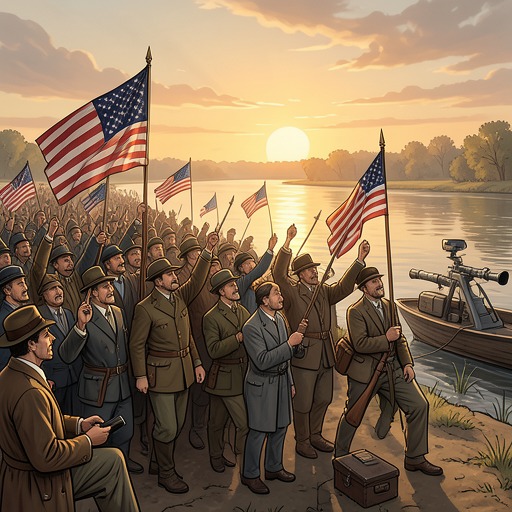
At ten thirty the next morning, newsreel cameras and flashbulbs recorded the athletes boarding. The Washington boys joined 325 other members of the U.S. Olympic team, each given a small American flag as the young passengers crowded the rails to wave at families and well-wishers on the dock. In tourist class, the rowers stowed their gear and met other American competitors: scullers, pairs, and four-oared crews representing clubs in Philadelphia, Massachusetts, and Buffalo.
The shell’s difficult passage aboard
Before the liner sailed, George Yeoman Pocock supervised the Washington crew as they loaded the Husky Clipper onto a long truck and, with a police escort, carried it through New York City to Pier 60. He had carefully sanded and varnished its hull at Travers Island, buffing successive coats to produce the fastest racing bottom he could. In Berlin, he believed, fractions of a second might decide the result.
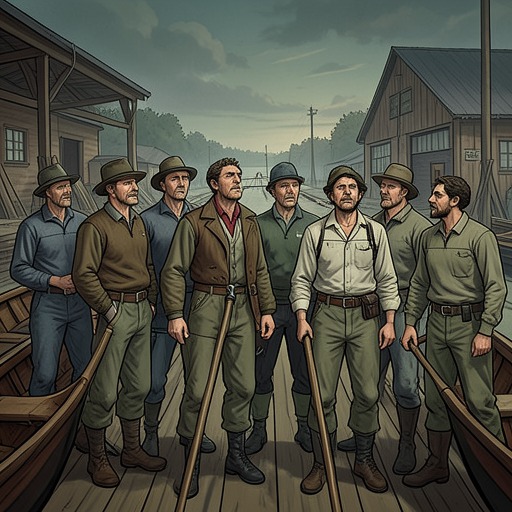
Getting the shell onto the ship proved harder than preparing it. At the crowded dock, the rowers—still wearing ties for a reception and dinner at the Lincoln Hotel—carried it over their heads through the humid heat, searching for a way past the ship’s great red hull. After nearly an hour, they found a baggage chute angled down toward street level. They fed the prow into it and crawled on hands and knees to work the shell up to the promenade deck. From there they lifted it overhead again, maneuvered it to the boat deck, tied it down, and covered it with a tarp, hoping no one would mistake it for a bench. The crew reached its reception massively late and soaked in sweat.
Departure from New York
The next morning the athletes bounded up the gangplank, charged with excitement at boarding a ship unlike any they had known. Tugs turned the liner downriver, and it proceeded past the Battery, Ellis Island, and the Statue of Liberty. Joe Rantz stayed on deck through the passage past Staten Island and Brooklyn, then out into the lower bay and Atlantic. He lingered at the rail in the cooling breeze, watching Long Island and taking in the unfamiliar journey so that he could tell Joyce Simdars about it when he returned home. Only after the afternoon sun declined and he had grown thoroughly cold did he go below to find the other rowers and food, beginning to find his sea legs.
A festive crossing toward Germany
That night, as the ship sailed northeast into darkness, it blazed with lights and rang with music and young people’s laughter. The exuberant scene gave the crossing the air of a holiday adventure, even as its destination was Hitler’s Germany. The night before, the Hindenburg had departed Lakehurst for Germany, its tail fins bearing large black swastikas. Against that image, the brightly illuminated liner carried the athletes toward the 1936 Olympics: a jubilant American departure set on a course toward a country whose politics shadowed the Games.